
Daily operations
Create and manage taskings
Assign accountable work to a Cadet or billet, track due dates, and preserve continuity through turnover.
Guide at a glance
How to use this guide
Start with
Define the operational outcome, owner, scope, and date before configuring the feature.
By the end
Current work is visible, ownership is unambiguous, and recurring responsibilities survive turnover.
Choose the right owner
Assign one-off personal work to a named Cadet. Assign continuing staff responsibilities to a position so the owner changes automatically with the billet.
A position-owned tasking avoids the common failure where recurring work remains attached to a Cadet who has graduated.
Define a useful tasking
- Use a title that describes the finished outcome.
- Add checklist items when the work has distinct parts.
- Set a due date when lateness matters.
- Choose a named Cadet or position deliberately.
- Keep supporting detail in the tasking rather than a separate chat thread.
Status and overdue behavior
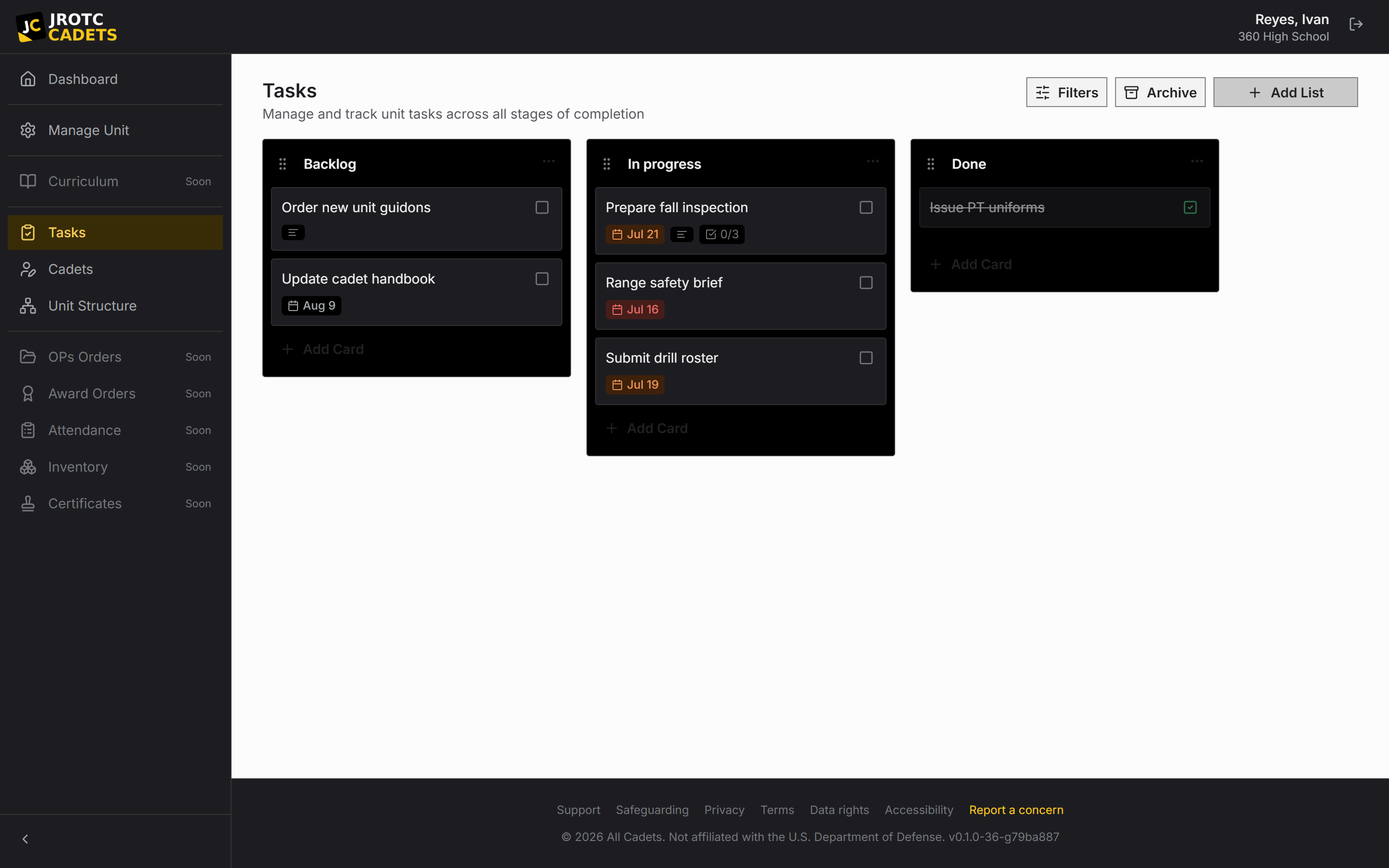
The board tracks tasking status, checklist completion, and due dates. Overdue is derived from the date rather than manually added, so late work surfaces without an instructor remembering to flag it.
A due date is useful only when someone owns the tasking and the expected completion is clear.
Review at turnover
Position-owned taskings continue with the incoming holder. Review the open board during change of command so the new holder understands what moved with the billet.
Close obsolete work instead of leaving it permanently overdue.
Practical playbook
Checks, outcomes, and troubleshooting
Use this section when you are carrying out the task now, or when the ordinary path did not produce the expected result.
Before you act
- Describe the finished outcome, not merely the activity, and choose a due date only when timing matters.
- Assign continuing staff work to a position and personal one-off work to a named Cadet.
- Put required detail and checklist items in the tasking so the assignee has one source of truth.
Success looks like
- Every open tasking has a clear owner, expected outcome, and meaningful status.
- Overdue work is intentional and reviewed rather than abandoned on the board.
- Position-owned work follows the billet during turnover and is understood by the incoming holder.
| What you see | Likely cause | What to do next |
|---|---|---|
| The incoming staff Cadet cannot find recurring work | The tasking was assigned to the outgoing person rather than the position. | Reassign continuing work to the billet and confirm the new holder is assigned to it. |
| A task shows overdue unexpectedly | The due date passed while the task remained open or its time context was misunderstood. | Check the exact due date, completion status, and whether the work should be closed or rescheduled. |
| Nobody knows what complete means | The title describes an activity without an outcome or checklist. | Rewrite the outcome and add verifiable checklist items. |
When to contact support. Include the task title, owner type, expected owner, due date, visible status, and whether the position holder recently changed.
Key terms in this guide
- Position
- A named unit duty that can carry permissions, scope, an assigned Cadet, and continuing work.
- Change request
- A proposed official change that keeps the current and proposed values available for review.
- Change history
- The attributable sequence of previous values, new values, actors, and times behind official changes.
Continue reading
Configure positions and permissions
Build a chain of command where responsibility and access survive annual turnover.
Read nextRun the approval workflow
Let Cadet staff propose official changes while instructors retain a clear review point.
Read nextRead the change history
Trace what changed, who acted, and what the record contained before the change.
Read next